.svg/200px-Australia_(orthographic_projection).svg.png) |
| Image Source: Wikimedia Commons |

September 18, 2013
Looking back: nominal and real GDP growth


.svg)
September 16, 2013
Dental checkup
 |
| Image source: Dental Council of NSW |
September 11, 2013
Measuring success in skilled migration policy: the subclass 457 visa program
 |
| Image source: Wikimedia Commons |

A new report by Monash University’s Centre for Population and Urban Research reveals that recently arrived migrants are dominating the growth in the number of employed persons in Australia. It also points to local young workers being adversely affected by the competition for employment, with a global pool of ‘job hungry temporary migrants looking for the same work’. According to the OECD, the young and the low-skilled will continue to be hardest hit across OECD nations through 2014.
September 5, 2013
Removing World Heritage by request?
 |
| Image: Area of Tasmanian Wilderness World Heritage Area, with the latest extension in orange. Parliamentary Library. |
August 29, 2013
Western Australia’s gas hopes float away
 |
| A liquefied natural gas (LNG) tanker. Image source: Wikimedia Commons |

August 22, 2013
Some insights into political (dis)-engagement
As Australian voters wrestle with their choice of parties and candidates in the 2013 Federal election campaign, the UK’s Hansard Society has released its annual audit of political engagement in Britain. Unlike Australia, voting in Britain is not compulsory.
August 19, 2013
Is an employee who resigns entitled to leave-loading on their unpaid annual leave?
Since the Fair Work Act 2009 (FWA) was introduced, there have been differing views regarding how to calculate the amount payable to an employee who has untaken annual leave when they cease employment. Is it calculated using the employee’s base rate of pay, or must it (if the employee is entitled to it) include leave-loading?
Stephen Edward Ryan v Whitehaven Coal Mining Pty Ltd (Ryan v Whitehaven)* may be the first case to have considered the issue. The court ruled that where an employee is entitled to leave-loading, the amount payable for any untaken annual leave must include leave‑loading.
Stephen Edward Ryan v Whitehaven Coal Mining Pty Ltd (Ryan v Whitehaven)* may be the first case to have considered the issue. The court ruled that where an employee is entitled to leave-loading, the amount payable for any untaken annual leave must include leave‑loading.
August 15, 2013
Safeguards and anti-dumping: Australia’s food processing industry seeks protection
 |
| Image source: Wikimedia Commons |

The company has been struggling since 2005 when it was bought by Coca-Cola Amatil for $500 million. The company’s management has described SPC’s performance as disappointing' , resulting in the decision to consolidate its three manufacturing plants into two and to write off more than $200 million of the company’s assets. Increased competition on the supermarket shelves from imported private labelled goods has resulted in the gradual decrease of the company’s market share, to its current level of around 30 per cent. Struggling to stay profitable and needing to restructure its operations, the company has asked the Federal government to impose duties on imported processed fruit and vegetables to give the industry some ‘breathing space’.
August 8, 2013
Two cheers for democracy in Southeast Asia?: recent elections in Malaysia, the Philippines and Cambodia
 |
| Image source: Election Commission of Malaysia |
July 26, 2013
Regional Resettlement Arrangement (RSA) and Australian aid to Papua New Guinea
 |
Image source: AusAID |
July 18, 2013
Historic new whistleblower protection laws
 |
| Image source: Free Vector |
July 17, 2013
The National Food Plan: food policy or something else?
 |
| Image source: wikimedia commons |
The Australian Government released the National Food Plan White Paper (the Paper) on 25 May 2013. At the time the then Minister for Agriculture, Fisheries and Forestry said ‘For the first time, Australia’s food businesses and consumers have a road map for the future…’ The Paper, however, is not about food for Australians; it has minimal focus on what Australians eat, or food processing in Australia. It is more an export plan, particularly for Australian producers.
July 15, 2013
Who is bound by the World Anti-Doping Code?
The previous FlagPost in this series examined countries that have criminalised doping in sport. This FlagPost examines who is bound by the World Anti-Doping Code (Code), National Anti-Doping Scheme (NAD) and various anti-doping policies in Australia. Is it just athletes and coaches, or are other people, such as sports scientists, also bound?
July 11, 2013
Complementary protection: open and accountable or 'opening the floodgates'
 |
| Image source: DIAC |
Media reports have suggested that the decision by the Full Federal Court in the case of SZGIZ v Minister for Immigration and Citizenship [2013] FCAFC 71 has ‘exposed an embarrassing loophole’ in current migration law that could ‘leave the door open to thousands of asylum seekers who have already been rejected as refugees’. While the decision is significant in that it allows for a further protection visa claim to be made by an individual who has previously had a claim rejected, the characterisation of the decision as potentially ‘opening the floodgates’ is dubious. At issue is not whether there are loopholes allowing for questionable claims for protection to be made, but the processes Australia engages to fulfil its protection obligations arising under international law.
UAVs: a vital part of Australia's future?
 |
| Image source: Wikimedia Commons |
Bill to reserve seats for women passed by Samoan Parliament
 |
| Image source: Wikimedia Commons |

The Legislative Assembly of the Samoan Parliament has voted unanimously in support of a bill to amend the Constitution to reserve five seats or 10 per cent of the 49 parliamentary seats for women electoral candidates. The Speaker of the Legislative Assembly, La’auli Leuatea Fosi, has called it ‘a new dawn for women’. The Constitution Amendment Act 2013 was passed by the Parliament on 24 June 2013 despite strong opposition by the Tautua Samoa party in the months leading up to the vote. Tautua Samoa had argued that the Government should seek the community’s views through a referendum and noted that, in some villages, women were not allowed to hold the title of matai (chief) which is a prerequisite for parliamentary candidates seeking election to the Samoan Parliament.
July 9, 2013
Segregated, stateless and at sea: Myanmar, the Rohingyas and Australia
 |
| Image source: US State Department |
Australia’s Minister for Foreign Affairs, Senator Bob Carr, will travel to Myanmar this week where he has stated he will raise the recent sectarian violence in Rakhine state, including the plight of the Muslim Rohingya minority, with the President and the Foreign Minister. He has previously flagged that he may seek to personally visit Rakhine to assess the situation as part of this trip.
July 4, 2013
For sale: Refurbished National Research Priorities
 |
| Image source: DIICCSRTE |
The Australian Government has just unveiled 15 new Strategic Research Priorities; the result of a long-awaited and thoughtful refurbishment.
July 3, 2013
New psychoactive substances: Key challenges and responses
 |
| Image source: EMCDDA |
False sense of safety associated with use
NPS are often marketed as ‘legal highs’ and professionally packaged, which can give the impression that they are safer to use than illicit drugs with similar effects. However, very little is known about their health impacts, partly due to the dynamic nature of the market and because the content and concentration of different batches of the same branded product may vary. A NSW Parliamentary inquiry was advised that synthetic cannabis products could actually be more harmful than cannabis itself, and that NPS may present a higher risk of overdose.
July 2, 2013
DisabilityCare Australia launches
 |
| Image source: DisabilityCare Australia |
This post provides a brief guide to some key aspects of the DisabilityCare Australia launch.
June 28, 2013
Synthetic drugs: Australian and international trends
 |
| Image source: US Government |
Streamlining Defence Acquisitions: the UK experiment
 |
Image source: Wikimedia commons
|

June 25, 2013
Australia's current debt position - update June 2013
This Flagpost article aims to present Australia’s current debt position and how it has changed since prior Flagposts on Australia’s debt position. This Flagpost updates the latest available data on Australia’s level of debt for both the public and private sectors in gross and net terms, and compares it with previously published data. For definitions of gross and net debt the reader is referred to the Library’s earlier Flagpost titled Australia’s current debt position.
June 24, 2013
US Trafficking in Persons Report 2013

Each year since 2001, the Office to Monitor and Combat Trafficking in Persons in the US State Department has produced a legislatively mandated report outlining major trends and issues in combating human trafficking and providing country by country analyses and ratings. The 2013 Report assesses 188 governments, including the United States, on their compliance with minimum standards set out in the Trafficking Victim Protections Act 2000 (TVPA). As the 2011 Report noted, the TVPA standards are ‘largely’ (though not entirely) consistent with the framework for addressing trafficking established by the Protocol.
June 18, 2013
World Refugee Day
 |
| Image source: UNHCR |
Exiting quantitative easing – the need for a deft touch and some luck
 |
Image source: Wikimedia commons |


June 17, 2013
Gene patents overturned in landmark US Supreme Court decision
The landmark decision of the US Supreme Court in the Association for Molecular Pathology v Myriad Genetics case would appear to have overturned three decades of gene patent awards, signaling a clear shift from the Patent and Trademark Office’s past practice.
Nearly 20 years ago, Myriad obtained several patents after discovering the precise location and sequence of the BRCA1 and BRCA2 genes, mutations of which can dramatically increase the risk of breast and ovarian cancer. This knowledge enabled Myriad to develop medical tests for detecting mutations in these genes to assess a patient’s cancer risk.
 |
| Image source: Jarek Tuszynski Wikimedia Commons |
Nearly 20 years ago, Myriad obtained several patents after discovering the precise location and sequence of the BRCA1 and BRCA2 genes, mutations of which can dramatically increase the risk of breast and ovarian cancer. This knowledge enabled Myriad to develop medical tests for detecting mutations in these genes to assess a patient’s cancer risk.
June 14, 2013
Law enforcement access to telecommunications data: neither secret nor new
 |
Image source: Australian Federal Police
|
June 11, 2013
ASIO security assessments of asylum seekers
 |
| Image source: ASIO |
June 6, 2013
Asylum seekers and income management
While media reports and commentary have suggested a relationship between the 'work for vouchers' proposal and income management, there are actually some significant differences between the two.
Countries trading greenhouse gas emissions
Over the last three years, the global carbon market has more than doubled in volume but almost halved in value. In that time a further eight countries, states or cities have adopted a carbon market as their primary means for reducing greenhouse gas emissions. Yet the price for one tonne of carbon dioxide equivalent has dropped by as much as 100 per cent in some markets.
A new paper from the Parliamentary Library provides a basic overview of the size and value of the global carbon market and details exactly which countries and regions are covered by a mandatory emissions trading scheme (ETS). Here is a snapshot of that paper.
A new paper from the Parliamentary Library provides a basic overview of the size and value of the global carbon market and details exactly which countries and regions are covered by a mandatory emissions trading scheme (ETS). Here is a snapshot of that paper.
May 31, 2013
Regulation of gambling advertising on TV - Live Odds and ACMA
On 26 May 2013, the Prime Minister promised
that ‘all promotions of odds by gambling companies and
commentators will be banned during the broadcast of live sports matches, under
new rules’.
The Government has demanded that Australian commercial TV
broadcasters amend their codes to ensure a reduction in the promotion and advertising
of gambling—especially live odds—during broadcasts of sport.
May 29, 2013
Question Time: Questions directed to non-government members
In Question Time on 28 May 2013 the Leader of the House, the Hon. Anthony Albanese, moved a Suspension of Standing and Sessional Orders (SSSO) to allow the Leader of the Opposition, the Hon. Tony Abbott, to address the House. The SSSO was moved to provide the Leader of the Opposition the opportunity to answer a question during Question Time – a rare and highly unusual occurrence.
May 28, 2013
The African Union’s Golden Jubilee: reflections on Australia’s relationship with Africa
 |
| Source: African Union |
May 24, 2013
The effectiveness of the Exporter Supply Chain Assurance System
 |
| Image source: QLD Department of Agriculture, Fisheries and Forestry |

The footage, obtained by Animals Australia, was filmed in October 2012 and April 2013 by Egyptian vet, Dr Mahmoud Abdelwahab and was aired on the ABC's 7.30 report. As a result, Australia suspended all live exports to Egypt on 3 May 2013. While acknowledging the ‘abhorrent abuses’ suffered by the cattle in the footage, the Australian Livestock Exporters’ Council, the Cattle Council of Australia and the National Farmers’ Federation maintain that animals should continue to be exported to Egypt. The three industry bodies have requested that the Government apply the Exporter Supply Chain Assurance System (ESCAS) to trade in Egypt (which applies to all other countries Australia exports to).
May 20, 2013
OECD Development Co-operation Peer Review: Australia 2013
 |
| Image source: OECD |
The current Review notes that since the 2008 Review, ‘AusAID has gone through the biggest change in its history’ which represents an ‘unprecedented reform of Australian development co-operation’ (p.13). The Review points out that 80 per cent (16 recommendations) of the 2008 Review has been implemented and 20 per cent (4 recommendations) partially implemented (pp. 9; 107–111).
May 10, 2013
Food Allergy Week 2013
 |
| Image source: US National Library of Medicine |
Paid Parental Leave: Robin Hood or piggy bank?
 |
| Image source: fahcsia.gov.au |
The difference between the two approaches highlights the complicated relationship present in both schemes between the idea of Parental Leave Pay as a workplace entitlement and a payment made through the social security system.
Surviving the first day of life
 |
| Image source: Wikimedia Commons |
Most babies die from preventable causes such as infections.
Every day, 800 women die during pregnancy or childbirth.
These statistics, released this week, are published in the 14th annual State of the World’s Mothers report by the organisation Save the Children. This FlagPost will show that the new born baby is still the most vulnerable and at risk of dying in both the developing and industrialised nations.
Asylum seekers and refugees—how will they be affected by this year’s Budget?
 It is expected that there will be several items in this year’s Budget directly affecting asylum seekers and refugees, some of which will require significant increases in expenditure. In particular, funding associated with the cost of intercepting and detaining irregular maritime arrivals (IMAs) is likely to increase significantly.
 However, other recent Government announcements affecting asylum seekers and refugees will also require additional funding—most notably the Government’s decision to increase the number of places available under the Humanitarian Program and the decision to increase the family reunion stream of the Migration Program by 4000 places for humanitarian entrants (and remove access to family reunion under the Humanitarian Program for IMAs). This FlagPost provides background on the changes to the Migration and Humanitarian programs that will have flow on effects for asylum seekers and refugees, both offshore and onshore.
May 8, 2013
Can means testing of welfare really save the budget?
 |
| Image: Robin shoots with Sir Guy (Louis Rhead, 1912), Wikimedia Commons |

The problem with such suggestions is that they are frequently light on details about precisely which welfare payments are the source of the 'problem' and what 'middle class' means. Nor do they tend to address the unintended consequences of making changes to eligibility for payments though tightening of means tests.
May 3, 2013
Raoul Wallenberg (4 August 1912–17 July 1947 (?))—Australia’s first posthumous Honorary Citizen
 |
| Image source: Wikimedia Commons |

A short history of increases to the Medicare levy

May 2, 2013
Health spending: patients bearing higher costs
 Recent reports have highlighted the growing cost of health services and the increasing financial burden on individuals. According to data from the Australian Institute of Health and Welfare (AIHW) Australia spent more than $130 billion on health in 2010–11, or around 9.3% of Gross Domestic Product (GDP). Around 70% of this was spending by Government—the Commonwealth and the states and territories combined, through programs such as Medicare, public hospital services and the Pharmaceutical Benefits Scheme (PBS). But a significant and growing component of health expenditure comes from individuals.
 April 30, 2013
Paying for the NDIS: what about a levy?
 |
| Image source: Australian Government |
This post outlines the importance of the financing issue and what the Productivity Commission recommended as a model for funding the NDIS. It highlights some of the key questions relating to the design of a levy for the NDIS.
April 24, 2013
Where in the world is doping a crime? (doping in sports pt. 6)
In the previous FlagPost in this series we examined actions related to doping in sport that can also be prosecuted as crimes in Australia. Do other countries criminalise doping in sport, or is Australia unique in having criminal offences that apply to conduct associated with Anti-Doping Rule Violations (ADRVs)?
Is doping in sport a crime? (doping in sports pt. 5)
The previous FlagPost in this series explored the dual use of evidence in both sports tribunals and criminal proceedings.
Whilst it is commonly understood that doping is prohibited in sport, is it also a criminal offence?
Whilst it is commonly understood that doping is prohibited in sport, is it also a criminal offence?
April 19, 2013
Higher education savings - students pick up the bill
 |
| Image source: Vic Department of Education |
Yet it is not the universities that will bear the brunt of the savings but their students.
April 16, 2013
And then there were none: HECS discounts
 |
| Image source: WA Dept of Commerce |
This move is the end of the line for two incentives that have been whittled away over the past ten years. Abolishing them is expected to save $230 million.
April 12, 2013
Boat arrivals on the mainland: what difference does it make?
 |
| Image source: www.immi.gov.au |
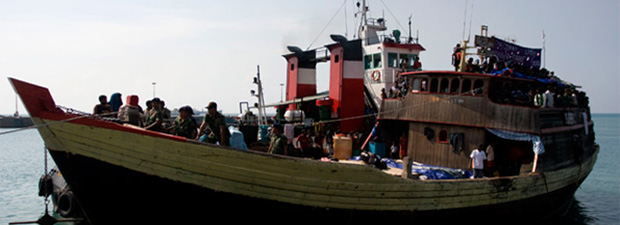
On 9 April 2013, Customs and Border Protection advised the Minister for Home Affairs that a suspected irregular entry vessel (SIEV) had arrived in Geraldton harbour in Western Australia. The boat is thought to have been carrying 66 people (officially known as irregular maritime arrivals or IMAs) from Sri Lanka.
According to Parliamentary Library research compiled from departmental and ministerial press releases, these were the first IMAs on Australia’s mainland since November 2008. According to the Minister for Immigration, there were 19 undetected mainland arrivals during the Howard Government—mostly prior to 2002. Between 2002 after the introduction of the ‘Pacific Solution’ and 2008 when the ‘Pacific Solution’ was formally dismantled by the Rudd Government there were four according to publicly available information:
April 11, 2013
‘Grandfather’ arrangements for PPS – entitlement or inequity?
 |
| Image source: Leichhardt Municipal Council |

Of Airports and High Speed Trains

The discussion of a High Speed Train (HST) along the east
coast of Australia has rumbled on for decades. But now it's running into the Sydney airport issue. The government has recently released a study into the feasibility
of a HST system and is completing another report about a location for a
second Sydney Airport (SSA).
The Australian
Greens argued in late 2012 that a new report, commissioned by Greens Deputy
Leader Adam Bandt, outlined a strong economic case for High Speed Rail (HSR)
and removed the need to build a second airport for Sydney. The study also
concluded that $48 billion in benefits would accrue from a HSR network along
the East Coast from Melbourne, to Canberra, Sydney and Brisbane. High
Speed Rail: Benefits that add up, A report for the Australian Greens, authored by Naomi Edwards, claimed that high-speed
rail would lead to shorter commute times, reduced congestion, fewer accidents,
and less pollution than existing transport options.
The dual use of evidence in both sporting tribunals and criminal proceedings (doping in sports pt. 4)
The previous FlagPost in this series explored what happens once a possible Anti-Doping Rule Violation (ADRV) is detected, and the role of sporting tribunals in determining and sanctioning athletes or support personnel who are found to have committed an ADRV.
As part of that process, ASADA (and also potentially Customs and the AFP) collect a variety of evidence. So when can evidence collected as part of an anti-doping investigation be used in criminal and civil proceedings and vice-versa?
This FlagPost examines the long-standing tradition of the ‘dual use’ of evidence in both civil and criminal proceedings in Australia and the situation with regard to sporting tribunals and criminal proceedings.
As part of that process, ASADA (and also potentially Customs and the AFP) collect a variety of evidence. So when can evidence collected as part of an anti-doping investigation be used in criminal and civil proceedings and vice-versa?
This FlagPost examines the long-standing tradition of the ‘dual use’ of evidence in both civil and criminal proceedings in Australia and the situation with regard to sporting tribunals and criminal proceedings.
Same conduct, two sets of proceedings
Proving doping: the ADRV enforcement process and the role of sporting tribunals (doping in sports pt. 3)
The previous FlagPost in this series explored what constitutes doping under the World Anti-Doping Code (the WADC) and the standard of proof required to prove Anti-Doping Rule Violations (ADRVs).
This FlagPost examines what happens once a possible ADRV is detected, either through evidence collected as part of an investigation or as a result of an adverse analytical finding (the detection of the presence of a substance or the use of a method on the Prohibited List in a sample provided by an athlete).
So how is an ADRV proved and prosecuted?
What is doping in sport? (doping in sports pt. 2)
The previous FlagPost in this series explored the reasons why particular substances and methods are included on the World Anti-Doping Code Prohibited List (the WADC Prohibited List) and hence banned in sport. This FlagPost examines the legal definition of ‘doping’ in sport provided by the World Anti-Doping Code (the Code).
So what is doping?
The Prohibited List (doping in sports pt.1)
The February 2012 Australian Crime Commission report into Organised Crime and Drugs in Sport has resulted in ongoing significant media attention and public interest in issues surrounding the supply, distribution and use of drugs in sport, and what might be done to combat doping in sports more generally.
As recent incidents involving Essendon AFL and the Cronulla and Manly NRL football clubs demonstrate, there can be confusion about the nature of supplements or drugs, and whether they are banned in sport and/or are illegal and/or are regulated under other rules. This is especially true when it is the class of substances or methods that is prohibited under the World Anti-Doping Code (WADC) Prohibited List and when expert medical or scientific advice is needed to determine whether the specific type of product that is being used falls within such a class.
So why are some substances and methods banned in sport?
So why are some substances and methods banned in sport?
April 9, 2013
Global asylum trends 2012: how does Australia compare?

The 2012 report, Asylum levels and trends in industrialized countries, recorded the second highest number of applications this decade with 479 300 asylum applications lodged (the highest level was in 2003 when there were 505 000 applications). Afghanistan remained the main country of origin of asylum-seekers in 2012, followed by Syria with a 191 per cent increase in asylum claims.
The High Commissioner for Refugees, António Guterres, noted that both new (Syria) and old (Afghanistan) conflicts were contributing to the rise in claims and that wars were ‘driving more and more people to seek asylum’. However, Guterres also pointed out that the asylum claims lodged in industrialised countries were only a drop in the ocean compared to the levels of displacement experienced closer to the regions of conflict:
In most cases people seeking refuge from conflict choose to remain in countries neighbouring their own in hope of being able to return home (an example is Syria, where the figure of 24, 800 Syrian asylum claims in industrialized countries compares to more than 1,100,000 registered Syrian refugees currently in neighbouring countries).
World Health Day: highlighting blood pressure
 |
Image Source: Better Health Channel Victoria |
April 8, 2013
Announcements end superannuation budget speculation?
 |
Image source: QLD government |
ABS public consultation on topics for the 2016 Census
 |
| Image source: ABS |
Under the Census and Statistics Act 1905, the Australian Bureau of Statistics (ABS) is required to conduct a Census of Population and Housing every five years. The next one is scheduled for August 2016 and planning is already well underway. An extensive review of topics collected in the Census is being undertaken to ensure that the data collected remains relevant to contemporary Australia.
April 2, 2013
Creative Australia : National Cultural Policy 2013
 |
| Image source: Wikimedia Commons |
Subscribe to:
Posts (Atom)