November 18, 2013

Littoral combat ships - lessons learnt from the US


Image source: Wikimedia commons
Less than a fortnight after the 2013 federal election, the new Defence Minister David Johnston indicated that the protection of Australia’s exports through maritime security would be a major Defence priority. In order to achieve this, the Minister claimed that ‘our navy needs a suitable mix of high-end war-fighting capabilities’ and accordingly, consideration should be given to acquiring littoral combat ships (LCS). This article summarises the US experience of acquiring LCS and outlines some key benefits and challenges the US has faced.

A return to Temporary Protection Visas?

Image source: Australian Human Rights Commission
On 18 October 2013 the newly elected Coalition Government registered an amendment to the Migration Regulations 1994 providing for the re-introduction of Temporary Protection Visas (TPVs). Unsurprisingly, given their vocal opposition to TPVs, the Australian Greens have moved to disallow the Regulation. This FlagPost provides an historical overview of the TPV, and outlines the arrangements that will be in place should the new TPV system withstand the disallowance motion.

Electoral quotas for women: an international overview

Dorothy Tangney DBE
Image source: Wikimedia Commons
courtesy Australian Freedom of Panorama
Electoral quotas for women: an international overview, published by the Parliamentary Library, provides an overview of recent global trends in women’s political representation and the different types of gender quotas adopted. Drawing on recent international research, it explains the impact of electoral quotas, what influences their success, and the various arguments for and against their use. The paper also looks at electoral gender quotas in Australia, and describes the use of quota systems in other Commonwealth countries. 

November 14, 2013

Zippers: former prime ministers leaving parliament

Of Australia’s 28 Prime Ministers Kevin Rudd has become only the fourth former prime minister to have lost an election or the leadership of his party and resigned from parliament shortly afterwards, bringing about a by-election.

November 13, 2013

Immigration: We can choose our skills, but we can't choose our family

Picture source: DIBP
Whilst boat arrivals, asylum seekers, skilled permanent and temporary programs and even students have kept immigration featured in our politics and newspapers, family migration receives little share of public debate. This is intriguing as family migration is a bigger part of permanent migration than official planning levels would lead us to believe.

Migration Program planning levels fluctuate according to the political, social and economic imperatives of the government of the day. In the mid-1970s, the planned annual intake reached a low of 50,000 places and gradually climbed to the 1988 peak of 145,000 and then reduced to 80,000 by 1993.

November 12, 2013

Aung San Suu Kyi and Australia’s new relationship with Myanmar

Image sourceWikimedia commons
The Australian Government has confirmed that Aung San Suu Kyi will visit Australia from 27 November to 2 December. This will be Suu Kyi’s first visit to Australia and follows her visits to the US, the UK, Europe, Japan, Singapore, and Thailand over the last eighteen months.

Traditionally, Western images of Suu Kyi have portrayed her as a lone heroine fighting tyrannical army generals. As Myanmar experts like Andrew Selth have argued, with her release from house arrest in late 2010 and the far-reaching reforms that are taking place in Myanmar, Suu Kyi now inhabits a much more complex set of roles in contemporary Myanmar politics.

October 30, 2013

Stronger targets proposed in Climate Change Authority draft report


Image source: Climate Change Authority
Today the Climate Change Authority (CCA) released a draft version of its ‘Targets and Progress Review’. The review, which according to the Clean Energy Act 2011 must be finalised by 28 February 2014, is to be used by the Minister in determining Australia’s emissions reduction goals under the carbon price mechanism. The draft report proposes two sets of caps; each set of caps defines a different emissions trajectory between now and 2020, and then to 2030. The CCA is calling for stakeholder input until 29 November 2013.

Has the United Kingdom sold their student debt?

Image source: Wikimedia commons
On a recent Q&A program Education Minister Christopher Pyne, in response to a question about selling HECS debt, stated: ‘Britain have sold their HECS debt as an asset and we should investigate whether that is a sensible move for us to do so.’ This Flag Post looks at the UK experience of selling some of their student loan; of a 2007 proposal to sell more that did not proceed and of recent proposals to again sell part of their student debt asset.

October 25, 2013

When experts conflict


Making decisions about complex public policy issues inevitably involves the assistance of experts. On occasion, however, experts in a given area disagree in their judgements.

In such cases, how can non-experts go about deciding which experts to believe?

October 22, 2013

Expertise and public policy: don’t just ask the experts


In recent years the number of highly technical policy issues considered by the Australian Parliament has increased. This means members and senators are obliged to grapple with the technical issues associated with all manner of topics, some of which have scientific or technological aspects.
 
But in order to reach a considered position and to have an authoritative basis for decision making, members and senators must achieve some grasp of these technical issues.
 
Thus, members and senators often find themselves in a difficult position—one that is shared by other non-experts: that is, that their ability to understand and reach a considered, informed judgement on the technical aspects of many debates is either limited or non-existent.

October 18, 2013

Time period between election date and first sitting date

It is up to the government to decide when parliamentary sittings will commence following an election, provided that the first sitting day is no later than 30 days from the date of the return of the writs. The election timetable is governed by the Constitution and the Commonwealth Electoral Act 1918. According to the timetable, the date of the return of the writs for the election is to be no longer than 100 days after it is issued, which is within 10 days after the election is announced.

First speeches

With the 44th Parliament due to open on 12 November new members will be making their first speeches in the opening weeks or months of the new parliament. The Chamber departments provide detailed notes for the guidance of new members when they are preparing their first speeches; this brief contains more general information and some historical background.

October 14, 2013

Payments to support victims of overseas terrorism

Image: 2002 Bali Bombing Memorial
Prime Minister Tony Abbott recently announced that victims of past overseas terrorist attacks would be entitled to an Australian Victim of Terrorism Overseas Payment (AVTOP), worth up to $75,000. The AVTOP was created in 2012 under the Gillard Government. Many of those affected by previous attacks have received some form of assistance from the Australian Government including coverage of medical costs and counselling/rehabilitation—the AVTOP provides a new formal mechanism for delivering monetary assistance. While there is strong community support for the scheme, a number of issues have been raised in regards to its design.

October 11, 2013

The US Debt Ceiling – some historical background and key links


Data from: US Treasury Monthly Statement of Public Debt.
The United States (US) Treasury has funds available to cover outgoing expenses until approximately 17 October. It cannot borrow more because of a legislative limit on borrowing (the ‘debt ceiling’). While a major default by the US Treasury would be unprecedented, historical examples do provide some insight into the costs caused even by delays in raising the debt ceiling.

October 9, 2013

Future growth in DSP receipt—not all bad news


Image source: Department of Social Services
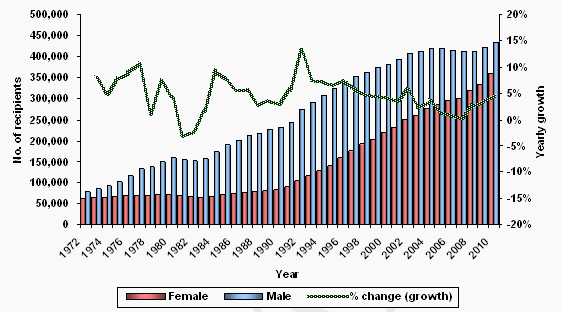
No doubt one of the priorities of the proposed review of income support payments will be the Disability Support Pension (DSP). DSP numbers have risen substantially in recent decades, despite numerous reforms designed to tighten eligibility and hence restrict growth. However a recent paper suggests that changes made to other income support payments have offset these reforms, and that the story is more positive than previous reports suggest.


October 8, 2013

What the latest IPCC report says about Australia

Image source: CAWCR
Since the 1900s the world has warmed an average of 0.85 degrees and the sea has risen an average of 19 cm. So affirms the 2,216-page draft report of the Intergovernmental Panel on Climate Change (IPCC) released on 27 September 2013 (see separate FlagPost on the IPCC). The first instalment of the IPCC’s Fifth Assessment Report (AR5) presents the latest science on global climate change. But Australia has a unique climate, influenced by both Indian Ocean events and the highly variable El Niño Southern Oscillation (ENSO) phenomenon. What does the latest IPCC report say about Australia?

October 4, 2013

What is the Intergovernmental Panel on Climate Change and how does it work?

Image source: CAWCR
The Intergovernmental Panel on Climate Change (IPCC) released on 27 September the first instalment of its eagerly anticipated Fifth Assessment Report (AR5). As with past reports, this one is likely to spark ongoing discussion about the threat from climate change and how to deal with it. But what is the IPCC and what exactly does it do?

October 3, 2013

Getting the balance right: U.S. perspectives on Defence reform


Image source: Wikimedia Commons
Australia and the United States share significant defence interests, especially regarding regional security across the Indo-Pacific. However, both nations also share a similar defence dilemma: the need to maintain appropriate defence capabilities despite facing increased financial constraints. A recent report by the U.S.-based Stimson Center provided almost 30 recommendations to reduce the U.S. Defense Department’s heavy financial burden, without (theoretically) jeopardising required capability. Despite the inherent differences between the Australian and U.S. defence organisations in terms of scale and scope, could the report’s recommendations be conceptually applied to the Australian context?

October 2, 2013

A close-run thing: the narrowest of margins [UPDATED]


Image Source: Wikimedia Commons
The Australian Electoral Commission has announced that the electorate of Fairfax will proceed to a formal recount in the 2013 federal election. Clive Palmer (Palmer United Party) leads with a margin of seven votes following the full distribution of preferences. Just how unusual is this outcome, and how many other close results have there been in Australian electoral history?

October 1, 2013

Electing the party leader

On 8 July 2013, then Prime Minister Kevin Rudd announced proposed changes to the way in which the Australian Labor Party elects its leader. The changes included votes by the party membership and votes by the Federal Parliamentary Labor Party (FPLP), weighted at 50% each, and processes for when and how a leader can be challenged and the amount of Caucus support needed to mount a challenge to the leader. The special meeting of Caucus on 22 July 2013 endorsed the proposals but agreed that a petition challenging the leader should require 60% Caucus support rather than the 75% proposed by Rudd. It was also agreed that, in the period between the federal election and the ALP election of its leader, the deputy leader or the highest ranked House of Representatives member would act as leader.