 |
| Image source: US Government |

June 28, 2013
Synthetic drugs: Australian and international trends


Streamlining Defence Acquisitions: the UK experiment
 |
Image source: Wikimedia commons
|

June 25, 2013
Australia's current debt position - update June 2013
This Flagpost article aims to present Australia’s current debt position and how it has changed since prior Flagposts on Australia’s debt position. This Flagpost updates the latest available data on Australia’s level of debt for both the public and private sectors in gross and net terms, and compares it with previously published data. For definitions of gross and net debt the reader is referred to the Library’s earlier Flagpost titled Australia’s current debt position.
June 24, 2013
US Trafficking in Persons Report 2013

Each year since 2001, the Office to Monitor and Combat Trafficking in Persons in the US State Department has produced a legislatively mandated report outlining major trends and issues in combating human trafficking and providing country by country analyses and ratings. The 2013 Report assesses 188 governments, including the United States, on their compliance with minimum standards set out in the Trafficking Victim Protections Act 2000 (TVPA). As the 2011 Report noted, the TVPA standards are ‘largely’ (though not entirely) consistent with the framework for addressing trafficking established by the Protocol.
June 18, 2013
World Refugee Day
 |
| Image source: UNHCR |
Exiting quantitative easing – the need for a deft touch and some luck
 |
Image source: Wikimedia commons |


June 17, 2013
Gene patents overturned in landmark US Supreme Court decision
The landmark decision of the US Supreme Court in the Association for Molecular Pathology v Myriad Genetics case would appear to have overturned three decades of gene patent awards, signaling a clear shift from the Patent and Trademark Office’s past practice.
Nearly 20 years ago, Myriad obtained several patents after discovering the precise location and sequence of the BRCA1 and BRCA2 genes, mutations of which can dramatically increase the risk of breast and ovarian cancer. This knowledge enabled Myriad to develop medical tests for detecting mutations in these genes to assess a patient’s cancer risk.
 |
| Image source: Jarek Tuszynski Wikimedia Commons |
Nearly 20 years ago, Myriad obtained several patents after discovering the precise location and sequence of the BRCA1 and BRCA2 genes, mutations of which can dramatically increase the risk of breast and ovarian cancer. This knowledge enabled Myriad to develop medical tests for detecting mutations in these genes to assess a patient’s cancer risk.
June 14, 2013
Law enforcement access to telecommunications data: neither secret nor new
 |
Image source: Australian Federal Police
|
June 11, 2013
ASIO security assessments of asylum seekers
 |
| Image source: ASIO |
June 6, 2013
Asylum seekers and income management
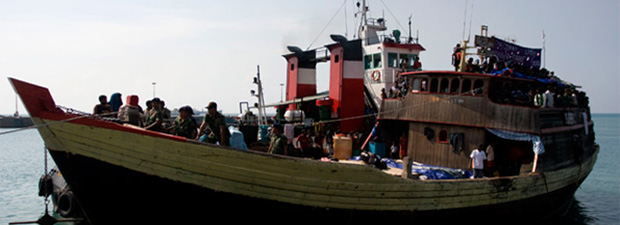
While media reports and commentary have suggested a relationship between the 'work for vouchers' proposal and income management, there are actually some significant differences between the two.
Countries trading greenhouse gas emissions
Over the last three years, the global carbon market has more than doubled in volume but almost halved in value. In that time a further eight countries, states or cities have adopted a carbon market as their primary means for reducing greenhouse gas emissions. Yet the price for one tonne of carbon dioxide equivalent has dropped by as much as 100 per cent in some markets.
A new paper from the Parliamentary Library provides a basic overview of the size and value of the global carbon market and details exactly which countries and regions are covered by a mandatory emissions trading scheme (ETS). Here is a snapshot of that paper.
A new paper from the Parliamentary Library provides a basic overview of the size and value of the global carbon market and details exactly which countries and regions are covered by a mandatory emissions trading scheme (ETS). Here is a snapshot of that paper.
May 31, 2013
Regulation of gambling advertising on TV - Live Odds and ACMA
On 26 May 2013, the Prime Minister promised
that ‘all promotions of odds by gambling companies and
commentators will be banned during the broadcast of live sports matches, under
new rules’.
The Government has demanded that Australian commercial TV
broadcasters amend their codes to ensure a reduction in the promotion and advertising
of gambling—especially live odds—during broadcasts of sport.
May 29, 2013
Question Time: Questions directed to non-government members
In Question Time on 28 May 2013 the Leader of the House, the Hon. Anthony Albanese, moved a Suspension of Standing and Sessional Orders (SSSO) to allow the Leader of the Opposition, the Hon. Tony Abbott, to address the House. The SSSO was moved to provide the Leader of the Opposition the opportunity to answer a question during Question Time – a rare and highly unusual occurrence.
May 28, 2013
The African Union’s Golden Jubilee: reflections on Australia’s relationship with Africa
 |
| Source: African Union |
May 24, 2013
The effectiveness of the Exporter Supply Chain Assurance System
 |
| Image source: QLD Department of Agriculture, Fisheries and Forestry |

The footage, obtained by Animals Australia, was filmed in October 2012 and April 2013 by Egyptian vet, Dr Mahmoud Abdelwahab and was aired on the ABC's 7.30 report. As a result, Australia suspended all live exports to Egypt on 3 May 2013. While acknowledging the ‘abhorrent abuses’ suffered by the cattle in the footage, the Australian Livestock Exporters’ Council, the Cattle Council of Australia and the National Farmers’ Federation maintain that animals should continue to be exported to Egypt. The three industry bodies have requested that the Government apply the Exporter Supply Chain Assurance System (ESCAS) to trade in Egypt (which applies to all other countries Australia exports to).
May 20, 2013
OECD Development Co-operation Peer Review: Australia 2013
 |
| Image source: OECD |
The current Review notes that since the 2008 Review, ‘AusAID has gone through the biggest change in its history’ which represents an ‘unprecedented reform of Australian development co-operation’ (p.13). The Review points out that 80 per cent (16 recommendations) of the 2008 Review has been implemented and 20 per cent (4 recommendations) partially implemented (pp. 9; 107–111).
May 10, 2013
Food Allergy Week 2013
 |
| Image source: US National Library of Medicine |
Paid Parental Leave: Robin Hood or piggy bank?
 |
| Image source: fahcsia.gov.au |
The difference between the two approaches highlights the complicated relationship present in both schemes between the idea of Parental Leave Pay as a workplace entitlement and a payment made through the social security system.
Surviving the first day of life
 |
| Image source: Wikimedia Commons |
Most babies die from preventable causes such as infections.
Every day, 800 women die during pregnancy or childbirth.
These statistics, released this week, are published in the 14th annual State of the World’s Mothers report by the organisation Save the Children. This FlagPost will show that the new born baby is still the most vulnerable and at risk of dying in both the developing and industrialised nations.
Asylum seekers and refugees—how will they be affected by this year’s Budget?
 It is expected that there will be several items in this year’s Budget directly affecting asylum seekers and refugees, some of which will require significant increases in expenditure. In particular, funding associated with the cost of intercepting and detaining irregular maritime arrivals (IMAs) is likely to increase significantly.
 However, other recent Government announcements affecting asylum seekers and refugees will also require additional funding—most notably the Government’s decision to increase the number of places available under the Humanitarian Program and the decision to increase the family reunion stream of the Migration Program by 4000 places for humanitarian entrants (and remove access to family reunion under the Humanitarian Program for IMAs). This FlagPost provides background on the changes to the Migration and Humanitarian programs that will have flow on effects for asylum seekers and refugees, both offshore and onshore.
Subscribe to:
Posts (Atom)