
 |
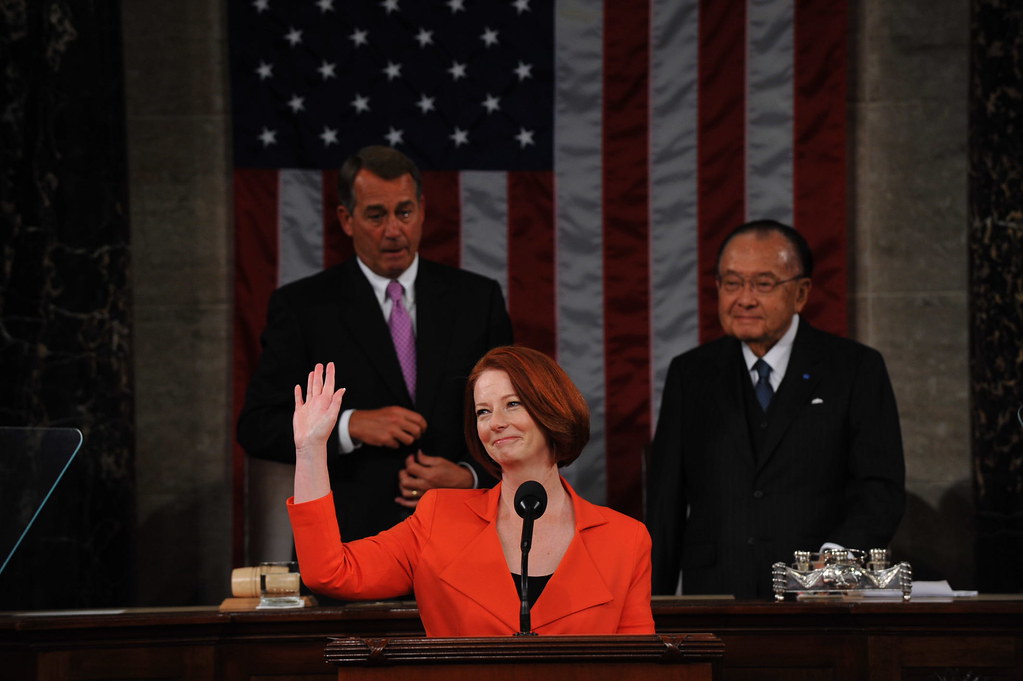
| Source: Prime Minister of Australia |
Joint sittings versus Joint meetings
Section 57 of the Constitution provides for joint sittings of the House of Representatives and the Senate, as a means of resolving disagreements between the Houses after a double dissolution election, if the disagreement still persists. This has occurred on only one occasion in 1974.
In 1992 a 'joint meeting' of the Houses was proposed by resolution that the Senate and the House of Representatives would meet concurrently in the chamber of the House of Representatives to hear the address of US President (President George H.W. Bush). This was to be a reciprocal honour provided to the visiting US President, as the Australian Prime Minister Bob Hawke had addressed a joint sitting of Congress on 23 June 1988. Table 2 lists Australian Prime Ministers who have addressed Congress.
A joint meeting was again held for the visit of US President Bill Clinton on 20 November1996 and in 2003 for the visits of both US President George W. Bush and President Hu Jintao of China.
Joint meetings are not provided for in the Constitution, and prior to 2004, were not provided for in Standing Orders. Prior to 2004, the procedure that was developed for a joint meeting was to have both Houses invite the foreign dignitary to address each chamber, by resolution, and for the House of Representatives to invite the Senate to meet in the House chamber to hear the address, with the Senate accepting that invitation. The Speaker would preside over the meeting and apply the procedures of the House of Representatives where applicable.
On 23 October 2003 an incident occurred where the Speaker of the House of Representatives named and suspended two Greens Senators, Senator Brown and Senator Nettle from the House for 24 hours. This was after they had interjected during President Bush's address and defied the Chair's orders to leave the address. The suspension then prevented them from attending the second address, that of President Hu Jintao, on the next day. This incident prompted a reference by the Senate to the Senate Procedure Committee to draw up and formalise guidelines on future joint meetings. The Committee recommended that the Senate pass a resolution 'that any future parliamentary addresses by visiting foreign heads of state should be received by a meeting of the House of Representatives in the House chamber, to which all senators are invited as guests'. This is now codified in the Senate Standing Orders as a resolution expressing the opinion of the Senate.
The House of Representatives Procedure Committee also considered the matter and made recommendations to the same effect.
On 27 March 2006, UK Prime Minister Tony Blair addressed parliament under the new arrangements. The same arrangements will occur for President Obama's address.
Table 1: Addresses to the Australian Parliament by foreign dignitaries
| 29 November 1951 | Delegation from the House of Commons: Rt Hon Richard Law. MP (Chairman), Rt Hon David Rhys Grenfell, MP and Mr Joseph Grimond, MP each addressed the House of Representatives when they presented the Mace to the Parliament on the occasion of its jubilee. |
| 2 January 1992 | US President George H.W. Bush |
| 20 November 1996 | US President Bill Clinton |
| 23 October 2003 | US President George W. Bush |
| 24 October 2003 | Chinese President Hu Jintao |
| 27 March 2006 | UK Prime Minister Tony Blair |
| 11 September 2007 | Canadian Prime Minister Stephen Harper |
| 10 March 2010 | Indonesian President Susilo Bambang Yudhoyono |
| 20 June 2011 | New Zealand Prime Minister John Key |
| 17 November 2011 (due) | US President Barack Obama |
Table 2: Address to Congress by Australian Prime Ministers*
| 1 August 1950 | Prime Minister Robert Menzies (addressed the House of Representatives, then the Senate) |
| 16 March 1955 | Prime Minister Robert Menzies (addressed the Senate, then the House of Representatives) |
| 23 June 1988 | Prime Minister Bob Hawke |
| 12 June 2002 | Prime Minister John Howard |
| 9 March 2011 | Prime Minister Julia Gillard |


No comments:
Post a Comment